
Which kind of tool do you need?
Choose by what you sell and where the decision happens. Lead distribution software decides which buyer receives each web lead and at what price, and manages the buyers themselves: their criteria, funding, caps, and returns. Ask who sets that price, because "bidding" means different things across the category: a price the operator types per buyer or campaign, a bid returned by a buyer's own server on a ping, or a bid the buyer sets and changes in a portal. Call tracking and pay-per-call software does the same job for phone calls, with tracking numbers, IVR, and ring trees that route a live caller to a buyer. Lead-flow automation such as LeadConduit sits upstream of either one, validating, enhancing, and filtering each lead in real time, and ActiveProspect positions it mainly for lead buying and validation. It can price leads and deliver them to several destinations in an order you set, but its documentation does not describe buyers bidding against each other.
Many lead businesses use more than one category. An agency selling web leads to its own buyers usually starts with lead distribution software such as Juiced; a pay-per-call network starts with call tracking software such as Ringba or Retreaver; a buyer or seller focused on consent and data quality may add lead-flow automation such as ActiveProspect's LeadConduit. Some platforms span categories: Phonexa pairs a lead ping-tree product with a call product, and TrackDrive markets real-time bidding for calls and inbound leads alongside lead-to-call automation. Compare those on the channel that carries most of your revenue.
How the three categories compare
| Question | Lead distribution software | Call tracking and pay-per-call software | Lead-flow automation and validation |
|---|---|---|---|
| What does it move? | Web form and API leads, from your sources to the buyers you manage. | Inbound phone calls, from tracking numbers to the buyer or call center that answers.[1][2] | Leads in flight between a source and a destination, such as a buyer system or CRM.[4] |
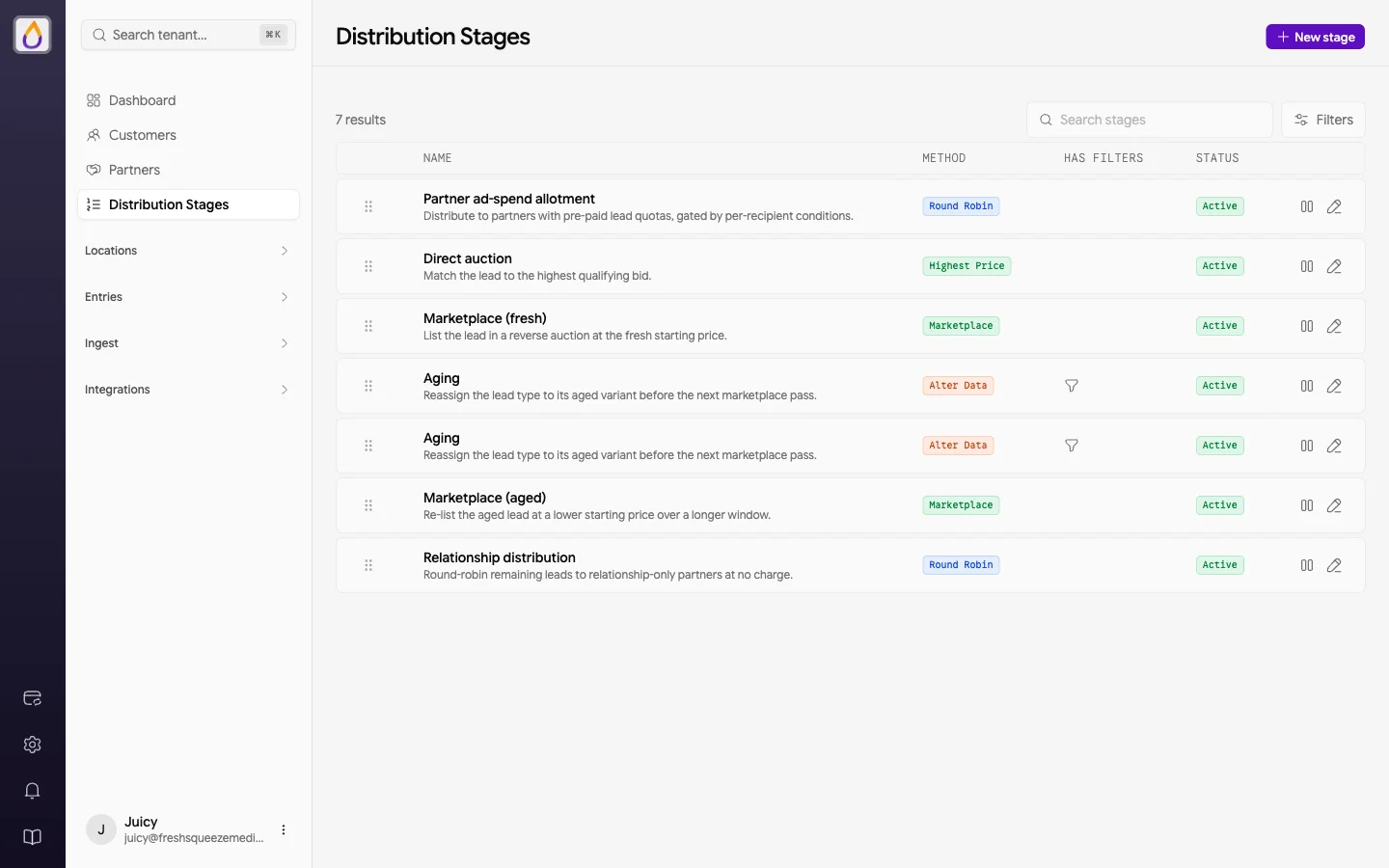
| What decision does it make? | Which buyer gets each lead and at what price, using distribution stages, buyer criteria, caps, budgets, and prices set by you or bid by buyers, with a marketplace fallback in some platforms. | Which buyer answers each call, using call routing rules and real-time bidding for calls.[2][3] | Whether to accept each lead (and, for a buyer, what to bid on a seller's ping), using validation, enhancement, and filter rules, then which configured destinations receive it, in a set order or all at once.[4][5][6][7] |
| Who works in it day to day? | Lead sellers and agencies running a buyer network, and, in some platforms, their buyers through a self-service portal. | Pay-per-call publishers, networks, advertisers, and call centers.[1][2] | Mostly lead buyers, plus sellers and originators managing data quality and consent.[4][8] |
| What does it record for disputes and returns? | A distribution record for each lead: which stages ran, which buyers were offered it, what they paid, and any return. | Call attribution, recordings, and call reporting.[1][3] | Each lead's validation and enhancement results, and buyer feedback such as conversions and returns.[4] |
| Examples | Juiced, Lead Prosper, boberdoo, LeadByte, LeadsPedia, LeadExec, and Phonexa's LMS Sync. | Ringba, Retreaver, TrackDrive, and Phonexa's Call Logic.[1][2][3][9] | LeadConduit by ActiveProspect.[4] |
Vendor descriptions summarize each vendor's own public materials, linked in the sources below. Several vendors span more than one category, so treat these as starting points and confirm scope with each vendor.
When lead distribution software fits
- Most of your revenue comes from selling web leads to buyers you manage.
- Buyers need to fund accounts, set caps, and bid by lead type and location without emailing your team.
- You want a controlled next step, such as a private marketplace, for eligible leads that do not sell on the primary route.
When call tracking software fits
- You sell or buy phone calls, and attribution, recordings, and ring-tree routing drive your revenue.
- You need tracking numbers, IVR, and real-time bidding on live calls.
When lead-flow automation fits
- Validation, enhancement, and consent evidence need to happen before leads reach any buyer system.
- You already have a distribution platform or CRM and want an upstream layer to filter and verify leads.
- You buy leads from several sellers and want to answer their pings with a price from your own rules.
Questions to answer before you compare vendors
- 1What share of your revenue comes from web leads, phone calls, or both?
- 2Who decides where each lead goes today, and what information do they use?
- 3What do your buyers need to manage themselves (funding, caps, bids, returns, or delivery settings), and do they need to see where their bid ranks?
- 4When a vendor says "bidding", who sets the price: you, a buyer's server, or the buyer in a portal?
- 5Where do consent evidence, validation, and duplicate checks need to happen in your flow?
Frequently asked questions
What is the difference between lead distribution software and call tracking software?
Lead distribution software routes web leads to buyers and manages those buyers' criteria, funding, caps, and bids. Call tracking software routes and attributes phone calls, using tracking numbers, IVR, and ring trees to connect a caller to a buyer. Some platforms offer both, but most are built around one channel.
Is lead-flow automation the same as lead distribution?
No. Lead-flow automation validates, enhances, filters, and delivers leads by rules you set, and can price them and send them to several destinations in an order you set. Lead distribution software adds buyer management and, in some platforms, buyer competition: bids, funding, caps, and returns. Many teams run a lead-flow tool upstream of a distribution platform or CRM.
Where does Juiced fit?
Juiced is lead distribution software for lead generation agencies and lead sellers. Buyers bid in a branded portal by lead type at county, state, or nationwide scope, see the current top bid and their position for that location, and fund a wallet by card; the winner pays one bid step above the next-highest eligible offer, or the minimum when unopposed. Eligible leads that do not sell can go to a marketplace where the price steps down to your floor and buyers can place buy orders. Juiced does not track or route phone calls.
Do I need more than one of these tools?
Often, yes. A business that sells both leads and calls may run a lead distribution platform alongside a call tracking platform, and a buyer focused on consent and data quality may add a lead-flow tool in front of either one.
Sources
Last updated
- [1]Ringba: Inbound Call Tracking for Pay Per Call. Accessed September 23, 2026. (archived)
- [2]Retreaver: Call Tracking for Inbound Calls. Accessed September 23, 2026. (archived)
- [3]TrackDrive homepage. Accessed September 23, 2026. (archived)
- [4]LeadConduit: Automate your lead flows. Accessed September 23, 2026. (archived)
- [5]ActiveProspect: Lead orchestration solutions. Accessed September 23, 2026. (archived)
- [6]LeadConduit API: Ping a source within a flow. Accessed September 24, 2026.
- [7]LeadConduit API reference (OpenAPI specification): pricing and distribution steps. Accessed September 24, 2026.
- [8]ActiveProspect blog: boberdoo alternative (LeadConduit vs. boberdoo). Accessed September 24, 2026.
- [9]Phonexa homepage. Accessed September 24, 2026. (archived)